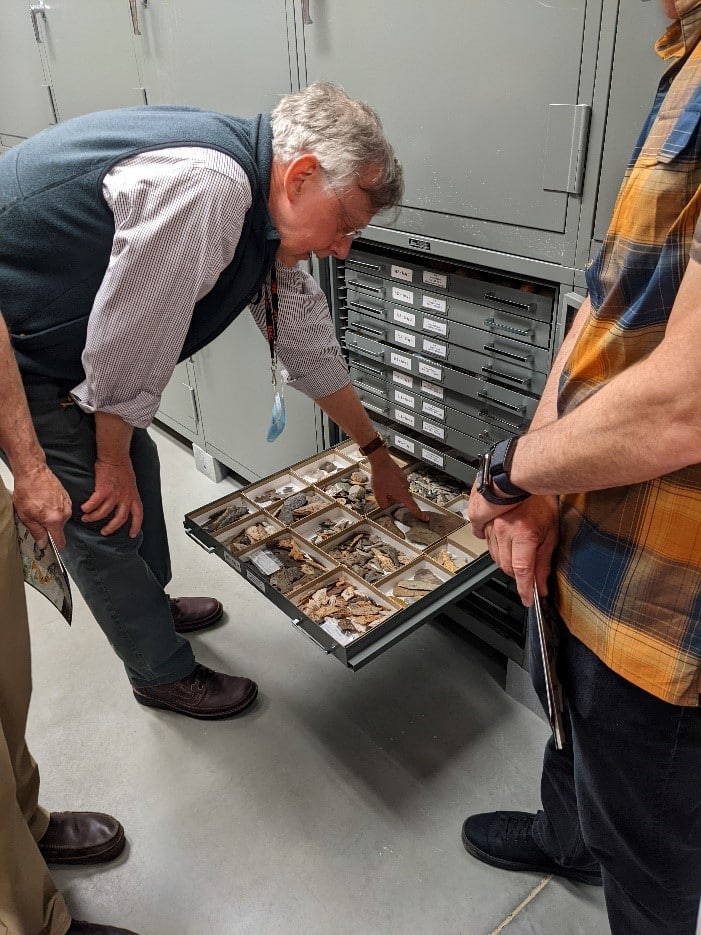
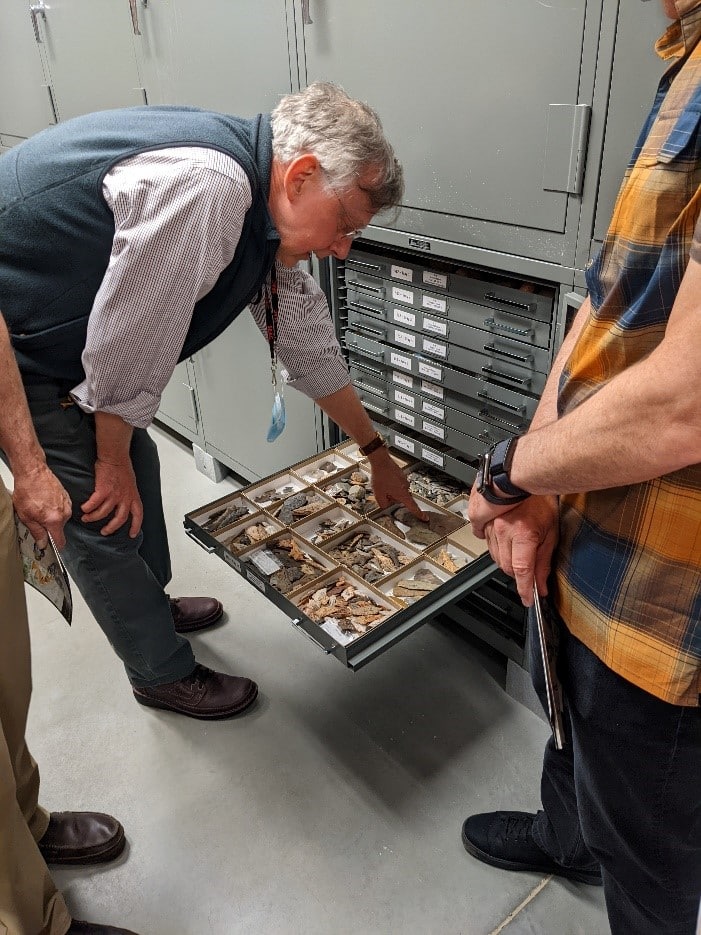
On May 12, 2022, Three Rivers Land Trust staff and board members traveled to the University of North Carolina – Chapel Hill for a private tour of a collection of ancient Native American artifacts discovered at the Hardaway site in Badin, North Carolina. TRLT staff spent the afternoon meeting with Dr. Vincas Steponaitis, a distinguished professor of Archaeology and Anthropology at UNC-Chapel Hill who focuses much of his work on studying ancient complex societies, ceramics, historic style trends, and iconography. The start of the tour began with Dr. Steponaitis recapping a brief history of the Hardaway site and the ancient civilizations that once inhabited the area.
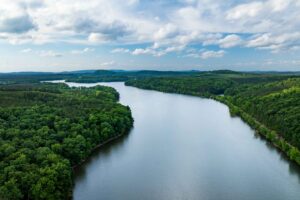
 The Hardaway site, located in Stanly County, is the oldest excavated site in the state. Dr. Steponaitis explained how the site’s geography and geology likely attributed to its frequent use within ancient civilizations. The Hardaway site exists on top of a ridge about 150 feet in elevation near Badin Lake within the Uwharrie Mountains. The geology of the site is composed primarily of rhyolite, which allowed the ancient people of North Carolina to find great success in harvesting rock from nearby ridges to construct spear points, shaping tools, and other utensils. The Hardaway site was first excavated in 1948 by Joffre Coe and Henry Doershuk and continued to be professionally excavated by professors and graduate students for the next thirty years. In total, thousands of ancient Native American artifacts have been discovered including pottery with detailed patterns and style markings, spear points and other projectile tips, smooth and jagged rocks that were used to craft stone into any desired shape, and hundreds of other utensils commonly used by the people that lived in this region so long ago.
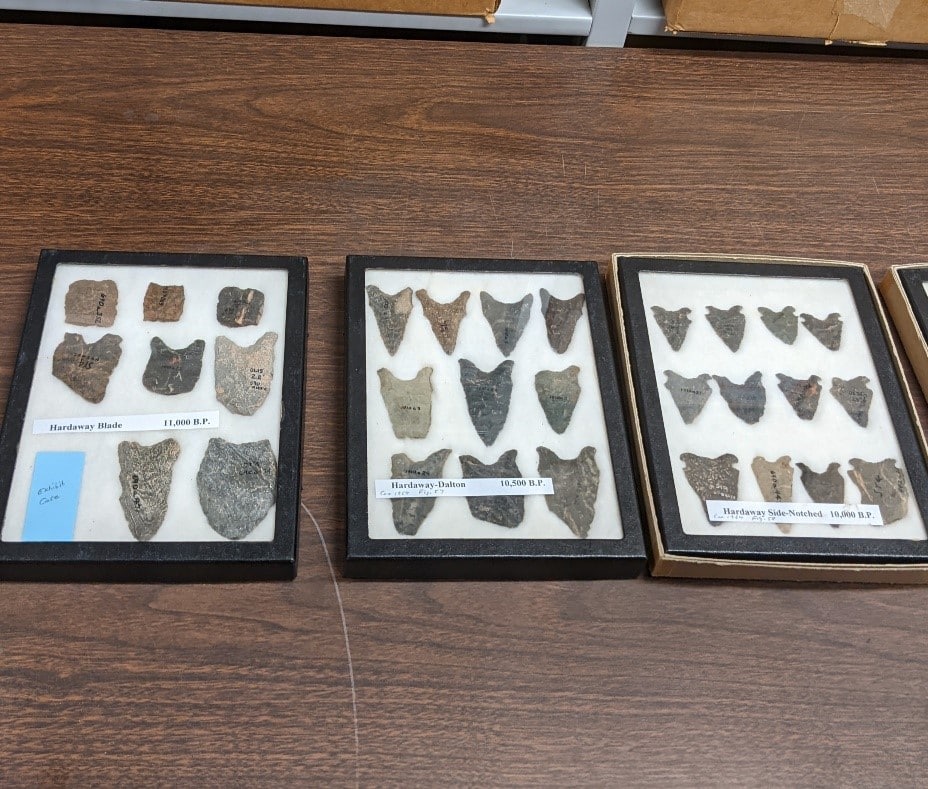
After this brief lecture, TRLT members were escorted across the UNC campus to an underground storage site where the artifacts are housed in climate-controlled spaces in secure storage containers to preserve their historical accuracy. There, staff we able to examine a wide variety of spear points found at the Hardaway site dating as far back as 12,500 years ago. Seeing collections of spear points on display, it was apparent how the style of spear points seemed to shift over time. Dr. Steponaitis likened this observation to the ways in which clothing or hairstyles in the modern world change across decades. TRLT staff were also shown pottery over thousands of years where the textures and patterns pressed into the clay reflect a similar change in styles over times. Andrew Younger, Director of Development at TRLT, reflected on his experience saying, “It was absolutely mind-blowing! Some of those projectile points were over eleven thousand years old. I left feeling amazed by what I saw, and grateful that TRLT is here to help conserve areas of historic significance”.
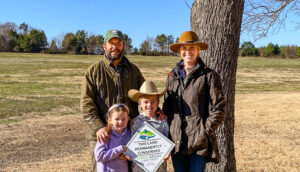
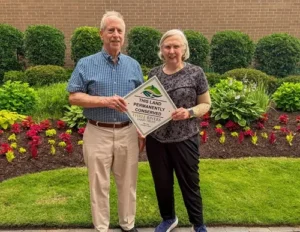
 Many thanks are extended to Dr. Steponaitis for leading the event and Joyce Fitzpatrick, on behalf of Alcoa, for organizing and inviting Three Rivers Land Trust staff and board members to attend. Beyond the incredible history of these artifacts, Three Rivers Land Trust is dedicated to preserving the unique natural areas within this and surrounding counties. In November 2021, TRLT was able to permanently conserve 215 acres of unique forest and rare plants only one half-mile away from the Hardaway site. Alcoa, a power generation company who formally owned much of the land in this area including the Hardaway site, entered into an agreement with North Carolina State Parks to donate roughly 1,400 acres, including the Hardaway site, to the North Carolina Division of Parks and Recreation in 2007. Since the 1980s, Alcoa has overseen management of the area and provided security and restricted access to ensure any historic findings are left to be found by archaeological professionals. The conservation of this property and other properties within this region is likely to preserve priceless historical artifacts, in addition to natural areas, for future generations.